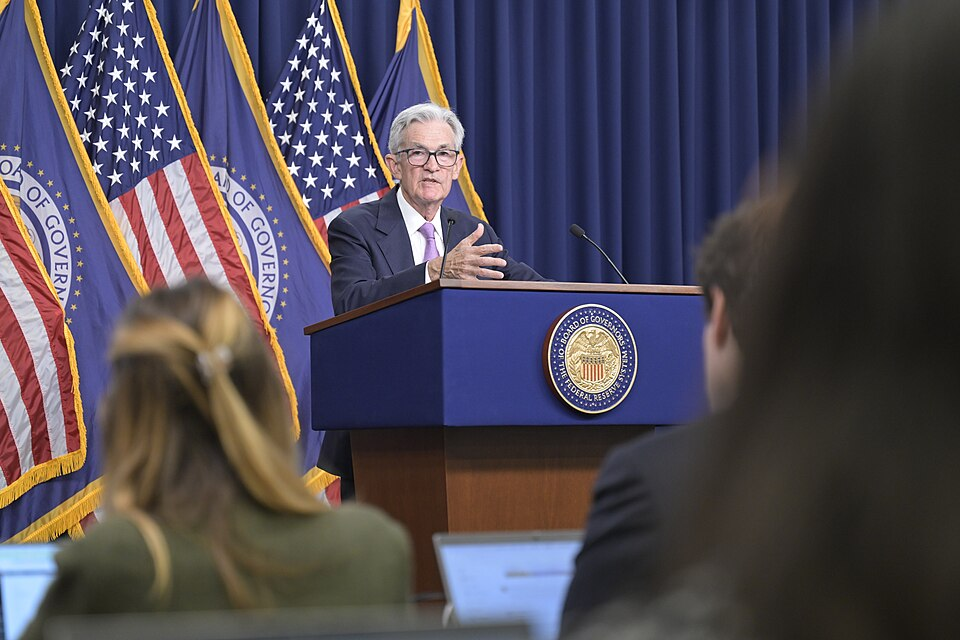

The Federal Reserve announced Wednesday it will maintain its benchmark interest rate at a range of 3.5% to 3.75%. While the decision to hold steady was expected by many analysts, the meeting was marked by a historic level of internal division and a defiant announcement from outgoing Chair Jerome Powell regarding his future at the central bank.
A Board Divided
The 8-4 vote to maintain rates represents the highest number of dissenting votes in a single Federal Reserve meeting since 1992. These four dissenters signaled a growing rift within the central bank, serving as a public warning to the incoming leadership. The friction comes as the Fed balances cooling inflation against the economic pressures of the ongoing blockade in the Middle East.
Powell’s Unprecedented Stay
Jerome Powell confirmed that his term as Chair will conclude on May 15. However, in a surprise move, he announced he will not retire from the Federal Reserve entirely. Instead, he will exercise his legal right to remain on the Fed board as a central bank governor.
Powell cited “unprecedented” actions and legal challenges brought against him by the Trump administration as the primary reason for his decision. “The things that have happened really in the last three months have, I think, left me no choice but to stay until I see them through,” Powell told reporters, slamming what he described as attempts to undermine the Fed’s independence. He clarified, however, that he does not intend to act as a “shadow chair” to his successor.
Kevin Warsh Nomination Advances
As Powell prepares to step down from the top spot, the path for his successor is clearing. The Senate Banking Committee voted along party lines Wednesday morning to advance the nomination of Kevin Warsh as the next Federal Reserve Chair. With Republicans controlling the Senate, Warsh is expected to be confirmed in a final floor vote shortly. (Financial Times, CNBC)
Why This Matters to You
The decision to keep interest rates between 3.5% and 3.75% means that the “cost of money” remains elevated. For your personal finances, this means interest rates on mortgages, auto loans, and credit cards will likely stay at their current levels rather than decreasing. If you were waiting for a rate cut to refinance a home or take out a loan, this pause suggests you may be waiting significantly longer.
In your community, the rare 8-4 split among Fed officials indicates deep uncertainty about the direction of the economy. When the “referees” of the financial system can’t agree, it often leads to market volatility. This can affect local businesses’ willingness to invest in new projects or hiring, as they wait to see which faction of the Fed wins the argument over future rate hikes or cuts.
On a broader level, the public conflict between Chair Powell and the White House is a shift in how the central bank operates. The Fed’s independence is designed to keep politics out of your pocketbook. If that independence is compromised, interest rate decisions might eventually be made based on political cycles rather than economic data, which historically leads to higher long-term inflation and less stability for your savings and retirement accounts.
-Elijah Iraheta, Editor in Chief, ASC News