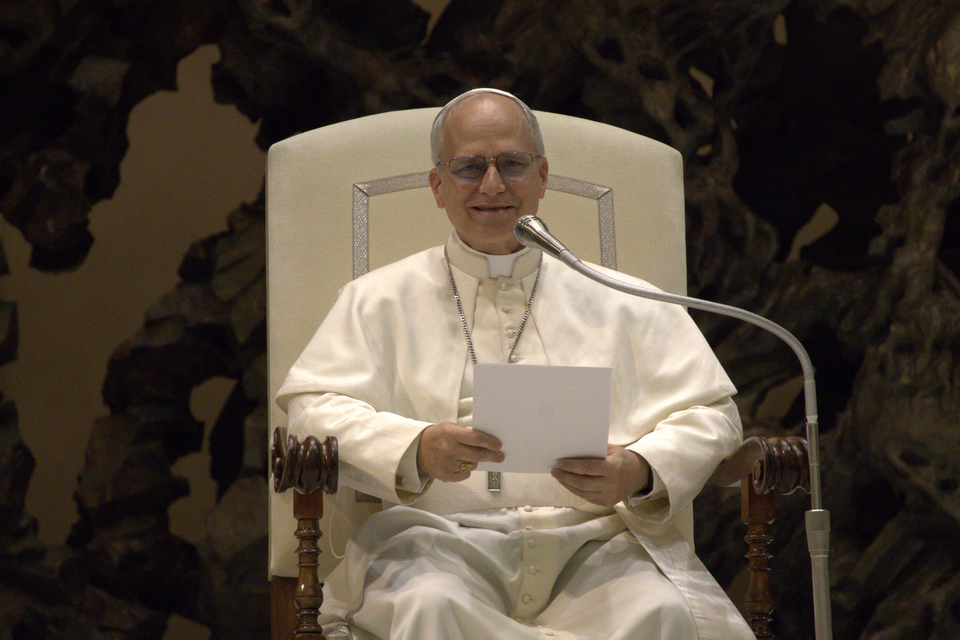

Pope Leo XIV issued a direct and pointed rebuttal Tuesday night to President Trump’s claim that the pontiff effectively supports Iran developing nuclear weapons, calling on those who criticize him to do so honestly and reaffirming the Catholic Church’s longstanding opposition to all nuclear arms.
Speaking to journalists after leaving the papal retreat at Castel Gandolfo near Rome, the first American-born pope said: “The mission of the church is to preach the gospel, to preach peace.” He added that the church’s position against nuclear weapons has been consistent and unambiguous for years, and that he hoped to be listened to “because of the value of God’s word.”
The remarks were a direct response to comments Trump made earlier Tuesday on a conservative radio program, in which the president said the pope “would rather talk about the fact that it’s OK for Iran to have a nuclear weapon,” adding that he believed Leo was “endangering a lot of Catholics and a lot of people.” The Vatican confirmed that Leo had not originally planned to speak to the press this week but decided to address the matter after Trump’s remarks. “Things have become really tense because Trump isn’t talking about the church or the Vatican, but Leo — he has made it personal,” said Andrea Vreede, a Vatican correspondent for Dutch public broadcaster NOS.
The dispute has been building for weeks. In April, Trump accused Leo of being “weak on crime” and “terrible on foreign policy” following the pope’s public criticism of the U.S. war on Iran. Trump also claimed Leo would not have been elected pope without Trump’s own presence in the White House — a claim that drew widespread criticism — and shared an AI-generated image depicting himself in a Christ-like manner before deleting it.
Secretary of State Marco Rubio is scheduled to meet with Leo at the Vatican on Thursday in what U.S. Ambassador to the Holy See Brian Burch described as a “frank” conversation. Rubio has sought the meeting for weeks and has publicly downplayed the rift between the Trump administration and the Vatican, acknowledging tensions while expressing confidence in the diplomatic relationship. Rubio will also meet Italian Prime Minister Giorgia Meloni on Friday. Trump publicly criticized Meloni in April after she declined to back the Iran strikes and expressed concern over his comments about the pope, and subsequently threatened to withdraw U.S. troops from Italy.
Vatican observers note that the Rubio meeting carries diplomatic stakes for multiple parties. The Vatican seeks a de-escalation of personal attacks from Washington. Rubio, who is widely considered a potential 2028 presidential candidate, has an interest in maintaining open channels with the Holy See. Some analysts have suggested Trump’s escalating attacks on Leo may be partly rooted in a desire to complicate Rubio’s diplomatic positioning ahead of a potential future primary contest.
Why This Matters to You
For the roughly 1.4 billion Catholics worldwide — including more than 70 million in the United States — the public conflict between the president and the pope carries weight that goes beyond political positioning. The Catholic Church is not a political institution, and its moral authority rests in part on its independence from the governments of the nations where its members live. When a sitting president publicly accuses the head of that church of endangering Catholics with his religious positions, it places Catholic Americans in an uncomfortable position between their faith and their political loyalties.
In your community, the substance of the dispute matters beyond its tone. Pope Leo has consistently called for a negotiated end to the Iran war and for the protection of civilian lives on all sides — positions grounded in the Church’s long-held teachings on just war and the sanctity of human life. Trump’s characterization of those positions as support for Iranian nuclear weapons is a significant misrepresentation of what the pope has actually said, and one that deserves to be evaluated on its factual merits rather than accepted at face value.
On a personal level, the Rubio meeting at the Vatican on Thursday is worth watching closely. Diplomatic engagement between the U.S. and the Holy See has historically played a meaningful role in international conflict resolution — from Cold War negotiations to humanitarian corridors in active war zones. Whether Thursday’s meeting produces a genuine easing of tensions or amounts to a photo opportunity with a difficult private conversation behind closed doors will say a great deal about whether the lines of communication between Washington and one of the world’s most influential moral voices remain functional.
-Elijah Iraheta, Editor-in-Chief, ASC News
Photo: Edgar Beltrán, The Pillar - Creative Commons Attribution-Share Alike 4.0