
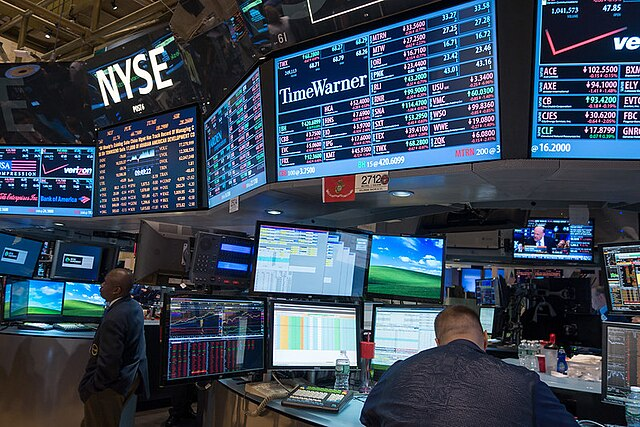

Global financial markets staged one of their strongest rallies of the year Wednesday as signs emerged that the United States and Iran may be approaching an agreement to reopen the Strait of Hormuz, sending oil prices sharply lower and stocks surging from Wall Street to Seoul.
The S&P 500 climbed 0.9% and was on course for another record, the Dow Jones Industrial Average gained roughly 498 points or 1%, and the Nasdaq composite rose 1.1%. International markets saw even larger moves, with South Korea’s Kospi jumping 6.5%, Paris rising 3%, London gaining 2.2%, and Hong Kong adding 1.2%.
Brent crude oil, the international benchmark, fell 5.8% to $103.54 per barrel, down from above $115 earlier in the week. The drop came after Trump posted that the strait could be “OPEN TO ALL” if Iran accepts a reported agreement — without providing details. Brent briefly dipped below $97 before recovering above $100 after Trump warned he would resume bombing “at a much higher level and intensity” if Iran declines the offer.
Several signals fed the optimism. Trump announced Tuesday he was pausing the military escort operation Project Freedom, suggesting diplomatic space was opening. China’s foreign minister called for a comprehensive ceasefire following a meeting with Iran’s foreign minister — a potentially significant development given the depth of China’s economic and political ties to Tehran. Markets have been burned before by false dawns on Iran peace hopes, and analysts cautioned the situation remains fluid and unpredictable.
Strong corporate earnings provided a parallel tailwind. AMD surged 15.8% after delivering better-than-expected profit and revenue, with CEO Lisa Su citing continued AI-driven demand for computing power in data centers. The company projected revenue growth of roughly 46% year-over-year in the current quarter. Super Micro Computer rallied 18.1% on similarly strong results, and Nvidia rose 4.4%.
Disney gained 8.3% after topping profit expectations, crediting its “Zootopia 2” release with boosting performance across streaming, theme parks, and cruise ships. CVS Health climbed 7.5% after raising its full-year financial forecast. Uber rose 7.6% on a stronger-than-expected bookings outlook. Airlines and cruise operators — companies with large fuel bills — also surged on hopes of sustained oil price relief, with United Airlines, Carnival, and Royal Caribbean each gaining between 4% and 6%.
In the bond market, the yield on the 10-year U.S. Treasury note dropped to 4.35% from 4.43% the prior day — a meaningful move that could ease borrowing costs on mortgages and business loans if sustained. The yield remains well above pre-war levels, however, reflecting the persistent economic damage from months of elevated energy prices and supply chain disruption.
Why This Matters to You
For your wallet, Wednesday’s market moves are the most directly encouraging financial signal since the Iran war began in late February — but caution is warranted. Oil prices fell sharply on the prospect of a deal, not a deal itself. If negotiations collapse or Iran rejects the reported U.S. proposal, prices could rebound quickly. That said, if a genuine agreement to reopen the Strait of Hormuz is reached and holds, the relief at the gas pump and across consumer goods prices could be substantial. Energy costs have been a primary driver of inflation since the war began, and their easing would be felt broadly across household budgets.
For your community, the drop in Treasury yields deserves attention beyond the financial headlines. When the 10-year Treasury yield falls, mortgage rates tend to follow — eventually. For anyone sitting on the sidelines of the housing market waiting for rates to ease, a sustained decline in yields tied to falling oil prices and reduced inflation pressure could meaningfully improve affordability conditions in the coming months. It is not a guarantee, but it is a development worth watching if homeownership is on your horizon.
On a personal level, Wednesday’s rally is a reminder of how directly the Iran conflict has shaped your financial life, whether or not you have been following it closely. Your retirement account, your gas prices, your grocery bill, and potentially your mortgage rate have all been affected by what happens in a narrow waterway on the other side of the world. A resolution to the conflict would not immediately undo all of that damage — but it would remove the primary source of economic uncertainty that has kept markets volatile and prices elevated since February. The next 48 to 72 hours of diplomatic developments are worth paying close attention to.
-Elijah Iraheta, Editor-in-Chief, ASC News