
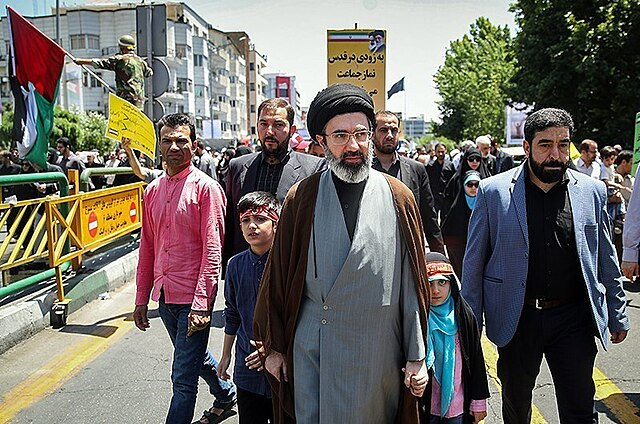
President Trump expressed displeasure Monday with Iran’s selection of Mojtaba Khamenei as its new supreme leader, saying he does not believe the 56-year-old can “live in peace” and suggesting the appointment may not last. Trump had publicly opposed Mojtaba’s selection for days before Iran made it official on Sunday.
What Trump Said
Trump made his feelings known across multiple interviews. He told Fox News he does not believe Mojtaba “can live in peace.” He told the New York Post he was “not happy” but declined to elaborate on how the US would respond. “Not going to tell you. Not going to tell you. I’m not happy with him,” he said. On Monday he told reporters he thought Iran “made a big mistake” and added: “I don’t know if it’s going to last.” (CBS News, Fox News, Al Jazeera)
Trump had already told Axios last Thursday that Mojtaba was “unacceptable” and “a lightweight,” comparing his desired level of involvement in Iran’s leadership selection to his administration’s role in Venezuela, where Vice President Delcy Rodriguez took over after the US captured and arrested President Nicolás Maduro in January. “I have to be involved in the appointment, like with Delcy in Venezuela,” Trump said. He told Time magazine on Friday: “I’m not going through this to end up with another Khamenei.” (Axios, Al Jazeera)
Trump also confirmed the decision to end the war will be made jointly with Israeli Prime Minister Benjamin Netanyahu. He described the military campaign’s results so far as “way beyond expectation in terms of result this early,” noting that more than 5,000 targets have been hit since operations began February 28. He said that striking first knocked out 50% of Iran’s missiles, adding: “If we didn’t, it would have been a much harder fight.” (Fox News)
What Iran Said
Iran’s government and military pushed back firmly against Trump’s framing. Iran’s parliament speaker Mohammad Baqer Ghalibaf called Trump’s desire to choose Iran’s leader “ridiculous.” IRGC commander Hossein Salami said: “The era of America dictating to nations is over.” Iran’s foreign ministry warned that any attempt to target Mojtaba Khamenei would be considered an act of war requiring an “overwhelming response.” Iranian Foreign Minister Abbas Araghchi said he was ready to negotiate but only on the basis of mutual respect and without preconditions. (Al Jazeera, CBS News)
Expert Analysis
Analysts pointed out that Trump’s repeated and public opposition to Mojtaba may have backfired. Ryan Costello, policy director at the National Iranian American Council, told Al Jazeera that Trump’s disapproval made it very hard for the Assembly of Experts to select anyone else without appearing to capitulate to foreign pressure. “It became not a question of who is the best candidate, but what do we need to do to protect Iranian sovereignty,” Costello said. He also noted that Trump appeared to have misjudged Iran’s willingness to fold. “Trump had very different expectations coming in, that Iran was weak and that they would fold like a deck of cards in a matter of hours,” he said. (Al Jazeera)
Republican Senator Lindsey Graham said Mojtaba was “not the change” the US was looking for and predicted he would meet the same fate as his father. Democratic Congressman Jake Auchincloss said Trump replaced “an 86-year-old terrorist dictator with a 56-year-old terrorist dictator” and warned the new leader would race for nuclear capability. Iran denies seeking a nuclear weapon. (Al Jazeera)
Why This Matters to You
Trump’s stated desire to be involved in choosing Iran’s leadership represents an extraordinary assertion of American power over another country’s internal governance. Whether that goal is achievable, or even legally permissible under international law, is a question that has not been fully answered publicly.
For everyday people, the more immediate concern is what happens next. If Trump views Mojtaba’s selection as a mistake that will not last, the war has no obvious end date. Oil at over $100 a barrel, rising gas prices, global market instability and seven Americans already dead are the direct consequences of a conflict that just acquired a new and defiant leadership on the Iranian side. It is worth thinking about: Does the US have the legal or moral authority to veto another country’s choice of leadership? If Trump’s public opposition to Mojtaba actually strengthened his selection, what does that tell us about the limits of American leverage in this conflict? And with Iran’s foreign minister signaling openness to negotiations while the military vows an overwhelming response to any targeting of the new supreme leader, which signal should the world be watching?
-Elijah Iraheta, Editor in Chief, ASC News

