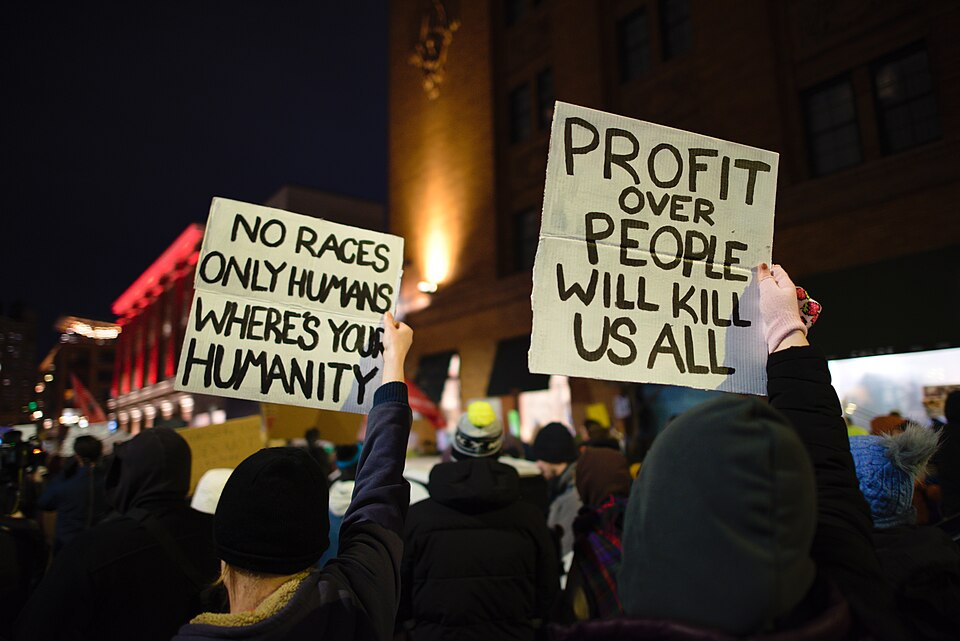

Thousands of Americans participated in coordinated demonstrations Friday across the country for International Workers’ Day, as part of the May Day Strong coalition’s nationwide call for an economic blackout — urging participants to skip work, school, and shopping for the day.
Organizers framed the day as a demand for a nation that puts workers over billionaires, centering three core issues: taxing the wealthy, opposing ICE and military action, and expanding democratic participation. Events were planned in every U.S. state and Washington D.C., anchored by more than 500 labor unions, student groups, community organizations, and immigrant rights groups. MAY DAY STRONG, Newsweek
On the East Coast, demonstrations were underway by early morning. In New York City, Amazon workers, Teamsters, and local elected officials marched from the main branch of the New York Public Library to Amazon’s nearby corporate offices, calling on the company to end its contracts with Immigration and Customs Enforcement (ICE) and the Department of Homeland Security. In Washington D.C., demonstrators shut down intersections across the city carrying signs reading “Workers over billionaires” and “Healthcare not warfare.”
This year’s mobilization follows last year’s May Day, which drew more than 1,000 actions nationally, and comes on the heels of the “No Kings” protests held across the country in March. Organizers say they expected more than double the number of events compared to the prior year. 12news.com
Education communities played a significant role in Friday’s actions. In Illinois, the Chicago Teachers Union secured an official designation of May 1 as a “day of civic action.” In North Carolina, at least 15 school districts gave teachers the day off to participate in a statewide rally for public education funding. Stacy Davis Gates, president of the Chicago Teachers Union and Illinois Federation of Teachers, said educators feel a direct accountability to the students and families they serve, connecting the day’s action to both economic pressures and the broader political climate.
Organizers describe the economic blackout as a step toward building toward a general strike — a form of collective action that has not occurred in the United States since before the 1947 Taft-Hartley Act placed significant restrictions on such activity. Shawn Fain, president of the United Auto Workers, has called for union contracts to be aligned to expire simultaneously on May 1, 2028, as a path toward that goal.
Some economists have questioned the practical economic impact of a single-day boycott, with University of Maryland Economics Professor Emeritus Peter Morici noting that consumers who skip purchases on one day typically make the same purchases shortly after, limiting any lasting financial effect on large corporations. Organizers, for their part, have framed the day less as an immediate economic blow and more as a test of collective organizing capacity for future action. Fox News
-Elijah Iraheta, Editor-in-Chief, ASC News
Photo: Fibonacci Blue – Creative Commons Attribution 4.0