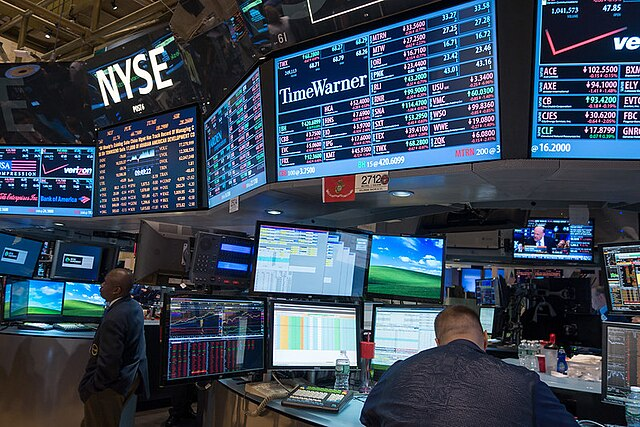

US stocks staged a dramatic reversal Tuesday, climbing back from steep early losses after President Trump suggested the Iran war could end “very soon.” Oil prices, which had spiked as high as $119 a barrel overnight, fell sharply on the remarks and on signals from G7 nations that emergency petroleum reserves could be released. Markets remain highly volatile and sensitive to every development in the conflict.
What Trump Said
The turnaround was triggered by a phone interview Trump gave CBS News reporter Weijia Jiang just after 3 p.m. “I think the war is very complete, pretty much. They have no navy, no communications, they’ve got no Air Force,” Trump said. He added the US was “very far” ahead of his initial four to five week estimated timeline. When asked if the war would end this week, Trump said no, but added “very soon.” At a Florida press conference later, Trump said the US was “achieving major strides toward completing our military objectives” and described the campaign as “just an excursion into something that had to be done.” Trump also said he plans to temporarily waive some oil-related sanctions and acknowledged talks with Russian President Vladimir Putin on the matter. (Fortune, NBC News)
However, hours later, Defense Secretary Pete Hegseth told reporters during a Pentagon briefing that the war would not end “until the enemy is totally and decisively defeated.” Netanyahu also said Israel was “not done yet.” The contradictory signals underscored the deep uncertainty still surrounding the conflict. (CNN)
Markets React
The Dow closed up approximately 340 points, or 0.5%. The S&P 500 gained 0.83% and the Nasdaq rallied 1.38%. The Russell 2000 small cap index rose 1%. Rising stocks outnumbered falling issues by roughly 2-to-1 on both major exchanges. Volume was notably lower than Monday’s session. (Fortune, Financial Content)
Airlines, which had been among the hardest hit sectors during the oil spike, bounced sharply. Delta and United each gained more than 3%. The 10-year Treasury yield slipped to 4.13%. Bitcoin climbed to around $70,700. European markets also rallied, with Frankfurt up 2.6%, London up around 2% and European natural gas prices down 15%. Asian markets surged, with Seoul’s Kospi rising more than 5% and Tokyo closing up 2.9%, recovering a significant portion of Monday’s steep losses. (Fortune, AFP via Branson Tri-Lakes News)
Goldman Sachs analyst Paul Markham of GAM Investments cautioned that “the idea that this will be a sustained rally from here, for me is quite difficult to believe,” adding that the Strait of Hormuz remains closed and the war is far from over. (Bloomberg)
Oil Pulls Back but Remains Elevated
WTI crude fell more than 16% from its overnight high to trade around $79 to $85 a barrel by the close, depending on the timing of Trump’s remarks. Brent crude fell to around $87 to $92 a barrel. Both remain significantly higher than pre-war levels. The Strait of Hormuz remains effectively closed to commercial tankers, with ships near the area reporting radio threats from Iranian forces. Storage capacity in the Gulf region continues to tighten. JPMorgan analysts warned that “with export bottlenecks unresolved and storage continuing to tighten, a further acceleration in regional supply cuts appears increasingly likely in the coming days.” (NBC News, CNN)
Saudi Aramco CEO Amin Nasser told analysts the company could “ramp up production in days and not weeks” if the situation stabilized, but also warned of potentially “catastrophic consequences” for oil markets if tanker flows through the Strait do not resume. (CNN)
The G7 asked the International Energy Agency to study the volumes that could be released from member nations’ strategic reserves. IEA Executive Director Fatih Birol, who participated in the G7 ministers’ meeting, said energy market conditions “have deteriorated in recent days” and that a substantial amount of oil production has been curtailed. The US Strategic Petroleum Reserve was 58% full heading into the conflict. (NBC News, Fortune)
Trump advisers also told the Wall Street Journal that the president had been reminded that sustained high oil prices would damage Republican chances in November’s midterm elections. That political pressure appears to have been a factor in Trump’s shift in tone. (Wall Street Journal via Fortune)
Why This Matters to You
Tuesday’s reversal offers a window into just how fragile the current market environment is. A single presidential phone call moved oil prices by more than $15 a barrel and swung the Dow by over 1,000 points from its intraday low to close. That kind of volatility creates real risks for everyday investors, pension funds and anyone with retirement savings tied to the stock market.
For consumers, oil below $90 is better than oil above $100, but the Strait of Hormuz is still closed, Gulf producers are still cutting output and no ceasefire has been announced. It is worth thinking about: If Trump’s “very soon” remarks move markets this dramatically, what happens if the war unexpectedly escalates again? With the US Strategic Petroleum Reserve only 58% full, how much of a cushion does the US actually have if this conflict extends for weeks? And with Defense Secretary Hegseth saying the war continues until total victory the same day Trump suggested it was nearly over, who is actually setting the terms for how this ends?
-Elijah Iraheta, Editor in Chief, ASC News