
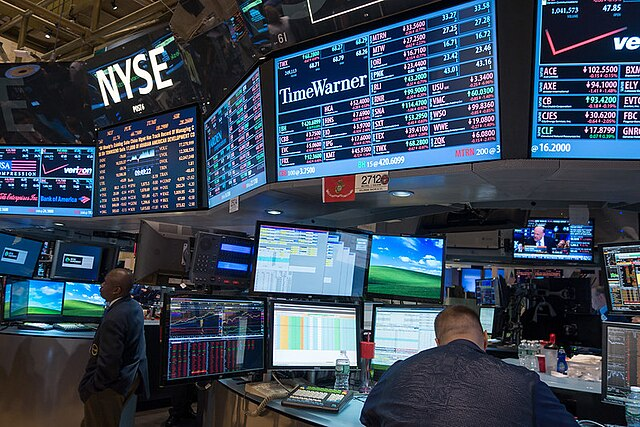

U.S. stock markets kicked off May with record-setting gains Friday, as strong corporate earnings and signs of potential progress in Iran peace negotiations lifted investor sentiment.
The S&P 500 rose 0.5% to a fresh all-time intraday high, the Nasdaq Composite added 0.8% and also scored a new record, and the Dow Jones Industrial Average advanced 112 points, or 0.2%. The gains built on an already historic April. The S&P 500 and Nasdaq logged their best monthly performances since 2020 in April, with the broader market gaining approximately 10% for the month. CNBC, Charles Schwab
The session’s standout mover was Apple. Shares climbed more than 3% after the company posted a fiscal second-quarter earnings and revenue beat, with better-than-expected revenue guidance for the current quarter overshadowing the fact that iPhone revenue fell short of estimates for the second time in three quarters. CNBC
Apple’s quarterly earnings came in at $2.01 per share on $111.18 billion in revenue, topping analyst expectations of $1.95 per share and $109.66 billion in revenue. TheStreet
Oil prices moved in the opposite direction, providing an additional tailwind for equities. Crude prices retreated as Pakistani mediators facilitated what appeared to be a potential breakthrough in the U.S.-Iran conflict, with Iran engaging with U.S.-backed peace amendments. West Texas Intermediate crude futures fell roughly 3%, while international benchmark Brent crude slid approximately 2%. The Motley Fool
The oil price surge since the Iran conflict began in February has driven U.S. gasoline prices up by 42% to 44%, reaching an average of $4.30 per gallon. Any easing of tensions in the region would carry significant relief for energy costs both for businesses and consumers. TheStreet
One theme reinforced this week across major tech earnings reports is that AI capital spending is not slowing, with outlays across the largest technology companies projected to approach $700 billion in 2026. However, markets are increasingly distinguishing between AI spending that shows near-term results and spending without clear returns — a dynamic that drove sharp divergence in how individual tech stocks traded following their quarterly reports. Charles Schwab
Some analysts caution that the rally may be due for a reality check. Consumer spending decelerated in the first quarter, and the personal savings rate declined, suggesting consumers tapped into savings to support their outlays. Additionally, first-quarter economic data captures only one month of disruption from the Iran conflict, meaning the full economic impact of elevated energy prices has not yet fully registered. MarketScreener
Why This Matters to You
For your wallet, the connection between stock market records and everyday life is real but uneven. If you have a 401(k), IRA, or any investment account, an S&P 500 at all-time highs is broadly positive news for your retirement savings. However, the simultaneous drop in oil prices is arguably the more immediate win — gasoline prices have risen sharply since the Iran conflict began, and any sustained decline in crude costs should eventually translate to lower prices at the pump.
In your community, Apple’s strong earnings are a signal of consumer technology demand holding steady despite a challenging economic environment. Apple employs tens of thousands of Americans directly and supports a vast ecosystem of suppliers, developers, and retailers. When the company performs well, it tends to have a positive ripple effect across that broader network.
On a personal level, this market moment carries an important caution worth keeping in mind: record highs do not mean risk has disappeared. Analysts note that consumer spending is already showing signs of strain, the full economic impact of elevated energy costs has not yet been fully absorbed, and historically May through October tends to be a weaker stretch for stocks. If you are making investment decisions, this is a moment where the headline numbers look encouraging — but the underlying conditions warrant careful attention rather than complacency. As always, consult a qualified financial advisor before making personal investment decisions.
-Elijah Iraheta, Editor-in-Chief, ASC News