
Stocks fell Wednesday after wholesale inflation came in more than twice as hot as expected, adding to already significant pressure on the Federal Reserve ahead of its interest rate decision later in the day. The Dow lost 351 points, or 0.8%. The S&P 500 and Nasdaq each fell 0.5%. Oil climbed further, with Brent crossing $109 and WTI approaching $99, after Israel struck Iran’s largest gas processing facility in Bushehr Province.
The PPI Shock
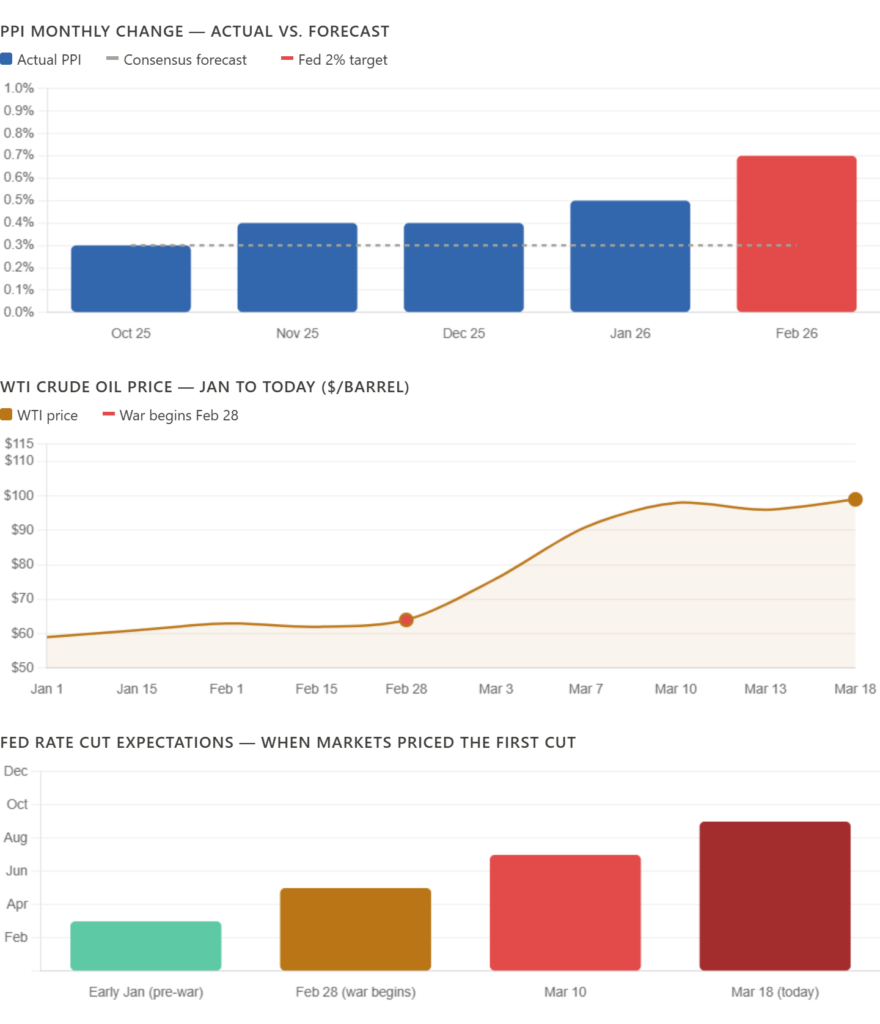
The Bureau of Labor Statistics reported that the Producer Price Index, which tracks wholesale prices that businesses pay before costs filter through to consumers, rose 0.7% in February. Economists had expected 0.3%. Core PPI, stripping out food and energy, rose 0.5%, also well above the 0.3% forecast. On a 12-month basis, headline PPI is now running at 3.4%, the highest since February 2025, while core is at 3.9%. The Fed targets inflation at 2%. (BLS, CNBC)
Critically, the February data was collected in the first two weeks of the month, before the Iran war began on February 28. None of the energy price surge from the conflict, which has pushed oil more than 70% higher since January 1, is captured in this report. March’s PPI, due April 14, will be the first reading to show those effects. (CNBC, BLS)
“The hotter than expected number is specific to tariffs,” said Todd Schoenberger, CIO at CrossCheck Management. “This is structural inflation, not temporary, and is likely going to impact monetary policy deep into the third quarter.” The Commerce Department separately reported its core PCE inflation gauge, the Fed’s preferred measure, is running at 3.1%, well above the 2% target. (CNBC)
The Fed Decision
Markets are expecting the Federal Reserve to hold its benchmark rate steady at 3.5% to 3.75%, where it has been since the last cut in December 2025. With the PPI report now public, futures traders are pricing in just one quarter-point cut for all of 2026, pushed out to September. Earlier in the year, three to four cuts were widely expected. Attention will focus on the Fed’s dot plot, which shows where individual policymakers project rates heading, and on Fed Chair Jerome Powell’s 2:30 p.m. press conference for any signals about how the oil shock will factor into future decisions. (Reuters, CNBC)
Oil and the Iran War
WTI futures rose 3% to around $99 a barrel. Brent added 5% to $109. The moves were driven by reports of an Israeli strike on Iran’s largest gas processing facility in Bushehr Province and renewed Iranian threats against energy infrastructure in Saudi Arabia, the UAE and Qatar. Iran launched a fresh wave of attacks on UAE energy infrastructure this week, including a strike on a fuel hub in Fujairah. The Strait of Hormuz remains largely impassable to commercial shipping. (Yahoo Finance, CNBC)
In an effort to ease the pressure, Trump invoked a 60-day Jones Act waiver Wednesday. The century-old law requires domestic fuel to be transported on US-flagged ships. The waiver allows oil, natural gas, fertilizer, coal and other energy commodities to flow more freely to US ports. White House press secretary Karoline Leavitt said the move would mitigate short-term disruptions to the oil market. (CNBC)
Micron and Tech
Micron Technology is set to report fiscal second-quarter earnings after the bell. The stock has rallied approximately 54-62% this year, benefiting from surging demand for high-bandwidth memory in AI data centers. Samsung co-CEO Jun Young-hyun described an “unprecedented supercycle” for the chip sector. Nvidia CEO Jensen Huang told developers at the annual GTC conference that he expects AI chip sales to surpass $1 trillion by 2027. Nvidia stock was trading marginally higher after China approved the sale of its H20 AI chips to Chinese buyers. (Yahoo Finance, CNBC)
Why This Matters to You
The February PPI report is the clearest signal yet that inflation was already re-accelerating before the Iran war began. The March and April reports will layer in the full impact of oil above $100, meaning the inflationary picture is almost certain to get worse before it gets better. For the Federal Reserve, a central bank legally mandated to control inflation and support employment, the combination of rising prices and a weakening labor market is as difficult an environment as it faces in a generation.
For everyday Americans, higher PPI eventually becomes higher CPI. It shows up at the grocery store, the gas station, the car dealership and in rent. With rate cuts now pushed to September and mortgage rates already at 6.30%, the cost of buying a home, borrowing for a car or carrying a credit card balance will stay elevated for months longer than most people anticipated coming into 2026. It is worth thinking about: If the March PPI captures the first full month of the Iran war’s energy shock, how much higher could wholesale inflation run in April and May? With the Fed holding rates elevated to fight inflation while a weakening labor market argues for cuts, which goal takes priority? And with the Jones Act waiver covering only domestic fuel flows, how much relief will it actually provide given that the global disruption is centered on the Strait of Hormuz thousands of miles away?
-Elijah Iraheta, Editor in Chief, ASC News