
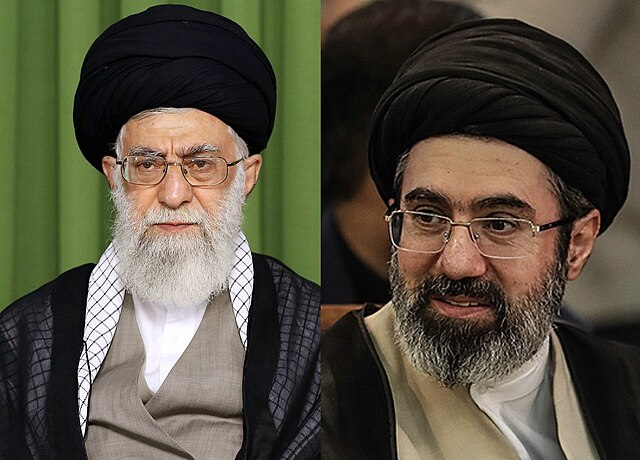
US intelligence has concluded that Iran’s late supreme leader Ayatollah Ali Khamenei had serious reservations about his son Mojtaba ever taking power, viewing him as unqualified and ill-suited for leadership. The assessment was shared with President Trump, Vice President Vance and a small circle of senior officials. The disclosure adds a new layer of uncertainty about who is actually running Iran as the war enters its sixteenth day.
What the Intelligence Shows
According to multiple sources familiar with the assessment, Ali Khamenei viewed his son as lacking the qualities required to lead the Islamic Republic. He was described as “not very bright” and unqualified for the role. The intelligence also indicated the father was aware his son had ongoing issues in his personal life. The specifics of those issues were not disclosed. The CIA, White House and Vice President’s office all declined to comment. (CBS News)
Trump referenced the intelligence publicly in a Friday Fox News interview without disclosing its classified basis. “Their leadership is gone. Their second leadership is gone. Now their third leadership is in trouble, and this is not somebody that the father even wanted,” he said. Privately, Trump has told people close to him he is not sure the information changes anything, since he believes Iran may effectively be leaderless regardless. (CBS News, Times of Israel)
The IRGC Power Question
The White House has privately concluded that Iran’s Islamic Revolutionary Guard Corps is now calling the shots in Tehran. That assessment represents a fundamental shift in how the US views Iran’s power structure. Since the 1979 Islamic Revolution, supreme authority in Iran has rested with a religious figure. If the IRGC is now the effective decision-maker, Iran is no longer a theocratic dictatorship in the traditional sense but rather a military government operating behind a religious facade. A senior Israeli official told Fox News that Mojtaba is “in low condition to function,” with IRGC personnel surrounding and managing him and Israeli intelligence monitoring his condition in real time. (CBS News, Fox News, Turkiye Today)
Iranian Foreign Minister Abbas Araghchi pushed back Sunday, saying Mojtaba Khamenei “is in good health and continues to fully manage the country.” Iran has still not produced video or audio of its new supreme leader. His first and only message since being named to the role was a written statement read aloud by a state television anchor on Thursday, in which he vowed to keep the Strait of Hormuz closed. (Jerusalem Post, Turkiye Today)
The Bounty
The US government on Friday offered up to $10 million for information leading to the location of Mojtaba Khamenei and nine other senior Iranian officials. The bounty underscores the administration’s stated goal of targeting Iran’s leadership structure directly as a means of ending the war. Defense Secretary Hegseth said Friday that Mojtaba is “wounded and likely disfigured.” Vice President Vance confirmed it appeared to be a strike that caused the injuries. (CBS News)
Why This Matters to You
For seventeen days the Iran war has been fought against a recognized government with an identifiable chain of command. If the IRGC has now effectively assumed control and Iran’s nominal supreme leader is wounded, in hiding and possibly incapacitated, the conflict has entered genuinely uncharted territory. There is no historical framework for negotiating an end to a war with a military organization that does not hold formal governmental authority.
For the rest of the world, an Iran governed by the IRGC rather than by clerical authority is potentially more dangerous, not less. The IRGC answers to no electorate and no religious law. It operates paramilitary networks across the Middle East, controls Iran’s missile program and has no tradition of diplomatic negotiation. It is worth thinking about: If the IRGC is now running Iran, who exactly does the US negotiate a ceasefire with? With a $10 million bounty on Iran’s supreme leader, is the US formally committed to a strategy of decapitating Iran’s government? And with Ali Khamenei’s own intelligence suggesting he never wanted his son to lead, does that create any opening for a different political outcome in Iran if the war ends?
-Elijah Iraheta, Editor in Chief, ASC News

