
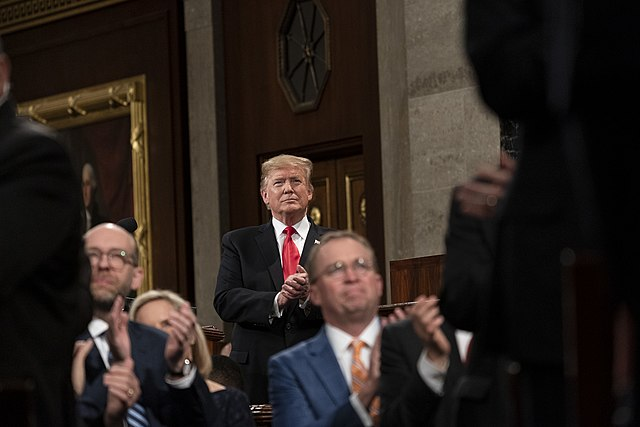
President Trump announced during his State of the Union address Tuesday night that he plans to give Americans without employer-sponsored retirement plans access to a new government-backed retirement account, modeled on the Thrift Savings Plan currently available to federal workers. He also said the government would match contributions of up to $1,000 per year for those who participate.
The White House says the proposal builds on the Secure Act 2.0, a law passed under President Biden that itself updated earlier legislation from Trump’s first term. A portion of that existing law, taking effect next year, already offers workers with retirement accounts up to $1,000 in matching funds if they contribute $2,000 of their own money. The new proposal aims to extend that access to the roughly 50 million Americans who currently have no employer-sponsored retirement plan at all. Rather than requiring people to open an Individual Retirement Account on their own, the plan would allow workers to simply check a box on their tax return to get started.
Experts offered a mixed response. Labor economist Teresa Ghilarducci, who worked on an early version of the plan, called it a big deal and said it finally acknowledges that most Americans have nothing saved for retirement. However, she predicted only around half of low-income workers would actually open an account, citing debt and tight finances as barriers. Financial services firm TIAA said it was encouraged by the focus on retirement access but wants to see more details before assessing how effective the proposal would be.
Others were more skeptical. Romina Boccia of the Cato Institute argued the administration lacks the fiscal authority to fund a $1,000 taxpayer match and said the country needs a simpler universal savings system rather than additional tax-advantaged accounts. Analyst Jaret Seiberg at TD Cowen told clients he sees no viable path for the plan to pass Congress as currently proposed.

