
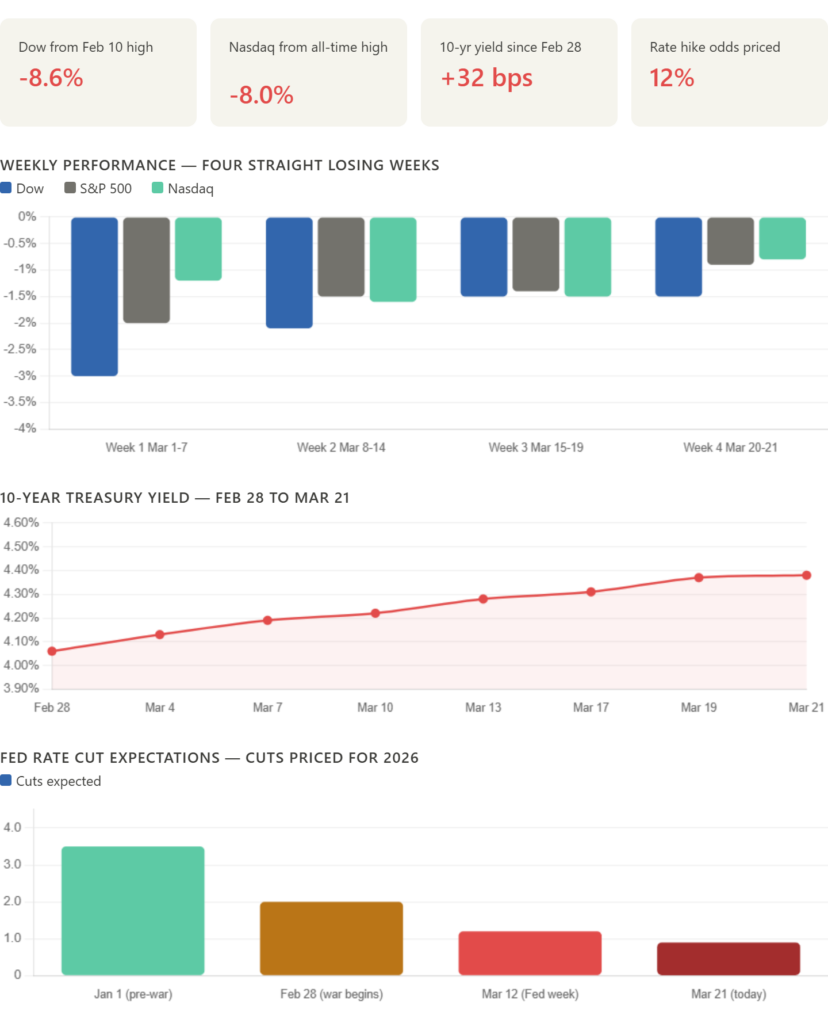
US stocks fell again on Friday, sealing the market’s fourth consecutive losing week, its longest such streak in more than a year. The S&P 500 fell 0.9% to 6,546. The Nasdaq lost 1.3% to 21,815. The Dow shed 0.4% to 45,822. The session was defined by three converging forces: continued Iran war uncertainty, a hawkish Federal Reserve that now projects just one rate cut for all of 2026, and the quarterly quadruple witching event that sent derivatives markets into a volatile spin. Approximately $5.7 trillion in options expired simultaneously Friday, one of the largest quadruple witching events on record.
The Four-Week Selloff in Numbers
The Federal Reserve’s revised dot plot, showing only one rate cut for 2026, rattled markets midweek. The probability of rates remaining unchanged through June jumped to around 89%, up from 63% just a week earlier. The CME FedWatch Tool now shows a more-than-likely chance that rates will stay at their current level through year-end, with roughly 12% odds of a rate hike now priced in.
The Dow is 8.6% below its record close set February 10. The Nasdaq sits more than 8% away from its all-time closing high. The S&P 500 closed below its 200-day moving average Thursday for the first time since last May, a technical signal that the long-term trend for the index has turned negative. Dip buying, which had characterized earlier 2026 market action, has largely been absent since the war began. Candlestick patterns have shifted from dip-buying eagerness to closing at or near daily lows.
The benchmark 10-year Treasury yield rose 10 basis points Friday to 4.383%, up 32 basis points since the war began. The 2-year yield added 10 basis points to 3.930%, up 42 basis points for the month. Rising yields make mortgages, car loans and credit card debt more expensive for consumers, and simultaneously reduce the attractiveness of stocks versus bonds for investors. (Investing.com, BNN Bloomberg)
FedEx Bucks the Trend
FedEx surged roughly 9% in premarket trading after crushing fiscal third-quarter estimates. The logistics giant reported adjusted earnings per share of $5.25 on revenue of $24 billion, comfortably beating expectations. The company also raised its full-year guidance, with CEO Raj Subramaniam crediting the company’s Network 2.0 restructuring initiative for efficiency gains.
Super Micro Collapse
Super Micro Computer plunged 25% after federal prosecutors charged the company’s co-founder Yih-Shyan “Wally” Liaw and two others with smuggling Nvidia chips into China. The charges hit the broader semiconductor sector, with Micron falling a further 4% and Nvidia trading down 0.9%.
The Marines Deployment
The Wall Street Journal reported, citing US officials, that the Pentagon is sending thousands of additional Marines to the Middle East. The US is also continuing strikes on military sites near Kharg Island, Iran’s top oil export terminal. Defense Secretary Hegseth said earlier in the week that the war would continue until the enemy is “totally and decisively defeated.” Analysts at Alpine Macro warned Friday that Iran’s Houthi allies in Yemen could attempt to close the Red Sea to commercial shipping, adding a second simultaneous strait disruption on top of Hormuz. A two-strait closure would impact an additional 5 million barrels per day of oil flows and impair the main Europe-Asia trade route, potentially pushing oil toward $200 a barrel. (Fortune, WSJ)
What Analysts Are Watching
The Atlanta Fed’s GDPNow model is tracking first-quarter GDP growth at 2.3%, down from 2.7% prior. The full fourth-quarter GDP estimate arrives next week. Unlimited CEO Bob Elliott told CNBC households are already absorbing 1 to 2% of real purchasing power destruction even if the conflict ends immediately. Deutsche Bank’s Jim Reid noted Friday marks the 15th trading day of the conflict, historically the average point at which US equities bottom out after a geopolitical shock, but cautioned that headlines will matter more than historical patterns this time around. (Schwab, CNBC)
Why This Matters to You
Four consecutive losing weeks. The S&P 500 below its 200-day moving average for the first time in ten months. Treasury yields up 42 basis points in a month. Rate cuts priced out for the year. These are not abstract market statistics. They are the financial system’s live assessment of where the economy is heading.
If you have a mortgage coming up for renewal, rates are heading higher, not lower. If you have a retirement account, it has lost value every week for a month. If you are planning a major purchase, borrowing costs are rising. And if the Houthis succeed in closing the Red Sea simultaneously with Hormuz, the economic shock could reach dimensions that make the current situation look manageable by comparison. It is worth thinking about: With the market pricing in a 12% chance of a rate hike, is the Fed moving from friend to threat for the economy? With $5.7 trillion in derivatives expiring on the same day markets are already fragile, how much of Friday’s volatility is the war and how much is the mechanics of the financial system amplifying it? And with Deutsche Bank noting markets historically bottom after 15 trading days of a geopolitical shock, is this the low point or just another step down?
-Elijah Iraheta, Editor in Chief, ASC News

