
US crude oil posted its biggest weekly gain in the history of futures trading on Friday, surging 35.63% for the week. That breaks a record dating back to the inception of the West Texas Intermediate contract in 1983. The move was driven entirely by the escalating US-Israeli war on Iran and the near-total shutdown of commercial traffic through the Strait of Hormuz.
West Texas Intermediate futures closed at $90.90 per barrel on Friday, up $9.89 or 12.21% on the day alone. That was the largest single-day jump in almost six years. Global benchmark Brent settled at $92.69 per barrel, up 8.52% for the day and 28% for the week, its biggest weekly gain since April 2020. Since the start of the year, WTI has now risen nearly 60%.
The Strait of Hormuz Crisis
The driving force behind the price surge is the near-complete halt to commercial shipping through the Strait of Hormuz. Typically, about 138 vessels travel through the Strait every 24 hours, but that has dropped to single-digit levels in recent days, according to the Joint Maritime Information Center. Google Fiber About 20% of global oil consumption passes through the waterway in normal times. The stoppage has left roughly 16 million barrels in limbo, trapped in the Persian Gulf with only limited diversions to reach buyers, according to data from Vortexa. inquirer
With nowhere to send their oil, producers have begun cutting output. Iraq has already shut down 1.5 million barrels per day. Kuwait has started cutting production after running out of storage space. Only nine empty VLCCs, the massive tankers used to transport crude, remain available to store oil from major Middle East producers. Once those are filled, onshore storage tanks will fill rapidly. Wikipedia
Qatar Warns of $150 Oil
Qatar’s energy minister Saad al-Kaabi gave one of the starkest warnings yet, telling the Financial Times that crude prices could reach $150 per barrel in the coming weeks if tankers remain unable to pass through the Strait. He said all Gulf exporters would be forced to declare force majeure, a legal mechanism that allows parties to suspend contracts due to circumstances beyond their control, within days if the situation continues. “This could bring down the economies of the world,” he said. (Financial Times, March 7, 2026)
JPMorgan’s head of global commodities research Natasha Kaneva warned in a Friday note that production cuts could approach 6 million barrels per day by the end of next week if the Strait remains closed. A Macquarie analysis projected cuts rising to 3.3 million bpd by day eight, 3.8 million bpd by day 15 and 4.7 million bpd by day 18. inquirer JPMorgan also expects the UAE to show supply constraints as early as next week.
The Trump Administration’s Response
The Trump administration announced a $20 billion insurance program for oil tankers in the Persian Gulf on Friday. However, the measure did little to calm markets. UBS analyst Giovanni Staunovo noted that refiners and trading houses are searching for alternative barrels, with the US emerging as the preferred source given its large domestic production base. airandspaceforces
Trump on Friday also demanded unconditional surrender from Iran, a move that raised fears of a prolonged conflict with no near-term resolution. Defense Secretary Pete Hegseth said Thursday the US had “only just begun to fight.” “Every day the Strait stays closed, prices will go higher,” Staunovo said. “The belief in the market was that Trump might pull back at some point because he doesn’t want to have high oil prices, but the longer that takes, the clearer it is how much is at risk.” airandspaceforces (Detroit News, March 6, 2026)
At the Pump
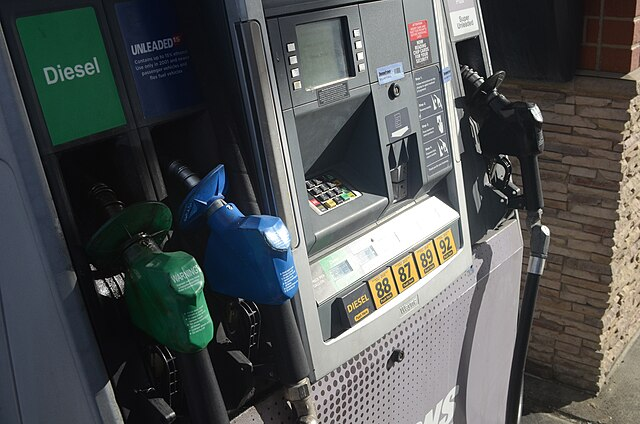
The impact is already being felt by everyday consumers. The national average for a gallon of regular gasoline has jumped roughly 27 to 35 cents in the past week to between $3.25 and $3.32 per gallon, the highest level since August 2024, according to AAA and price-tracking service GasBuddy. TD Securities senior commodity strategist Ryan McKay said Brent crude could top $100 a barrel by next week if tankers remain unable to traverse the Strait. Google Fiber (CBS News, March 7, 2026)
Wall Street Reacts
Stocks also dropped sharply, with the Dow Jones Industrial Average posting its worst week since April 2025. NBC News (NBC News, March 7, 2026) Goldman Sachs set its second quarter price target for oil at $76 per barrel while acknowledging prices will likely remain in the $80s through March, but noted that risks to its forecast are significantly skewed to the upside.
Why This Matters to You
A 35% surge in oil prices in a single week is not just a number on a trading screen. It is a cost that filters through the entire economy. Higher oil means higher fuel, higher shipping costs and higher prices for nearly everything that moves by road, sea or air. That includes groceries, household goods and anything imported from overseas.
For everyday Americans already dealing with elevated prices, the timing could not be worse. Pump prices are rising fast and analysts warn they could go higher still. It is worth thinking about: If $150 oil becomes a reality, what does that mean for household budgets, airline tickets and the cost of food? With the Trump administration demanding unconditional surrender from Iran and signaling weeks more of fighting, how long can global energy markets absorb this kind of disruption? And with the US now the world’s largest oil producer, could domestic supply become a buffer, or will export demand drive prices higher regardless?
-Elijah Iraheta, Editor in Chief, ASC News

