
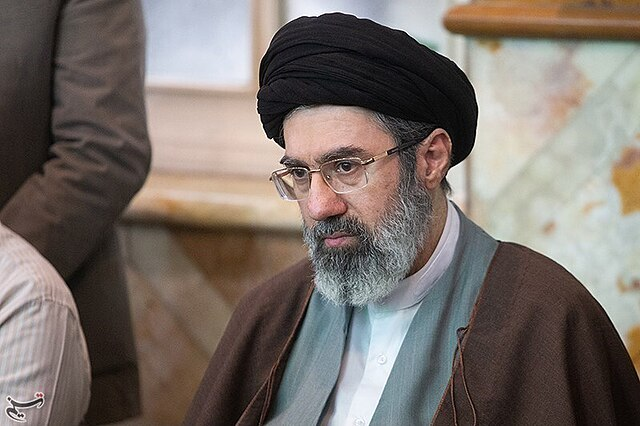
Iran has confirmed Mojtaba Khamenei, 56, as its new supreme leader. He is the second son of Ayatollah Ali Khamenei, who was killed in a joint US-Israeli strike on Tehran on February 28. The Assembly of Experts formally named him on Sunday, making him only the third supreme leader in the Islamic Republic’s 47-year history. Iranian state media also confirmed he has been wounded, describing him as “janbaz,” or wounded by the enemy, in the “Ramadan war,” Iran’s term for the current conflict. (Times of Israel)
Who Is Mojtaba Khamenei
Mojtaba Khamenei was born in 1969. His childhood was shaped by the 1979 revolution that toppled the Pahlavi dynasty and by his father’s rise to power, first as president in 1981 then as supreme leader in 1989. He served in the IRGC’s Habib Battalion during the Iran-Iraq War, where he built lasting relationships with commanders who would go on to dominate Iran’s security and intelligence apparatus. He studied under the late Ayatollah Mohammad Taghi Mesbah Yazdi, who called for killing Iranian youths who promoted Western immorality. (Axios, Al Jazeera)
Despite years as one of Iran’s most powerful figures behind the scenes, Mojtaba has never run for office, never given a public lecture or Friday sermon and has never delivered a political address. Many Iranians have not heard his voice. (Al Jazeera)
A History of Suppression and Political Manipulation
Mojtaba has close ties to some of the most ideologically extreme clerics who led Iran’s most violent crackdowns, according to the Council on Foreign Relations. He is alleged to have engineered the 2005 election that installed Mahmoud Ahmadinejad as president. When millions of Iranians took to the streets in 2009 to dispute Ahmadinejad’s re-election, Mojtaba reportedly personally supervised the IRGC’s suppression of those demonstrations. (Axios)
Notably, his father Ali Khamenei had reportedly floated potential successors with stronger administrative and theological credentials, and Mojtaba was not among them, according to the Council on Foreign Relations. IRGC commanders applied significant pressure on Assembly of Experts members to vote for Mojtaba, with repeated contacts and what sources described as psychological and political pressure during the online session held March 3. (Axios, Wikipedia)
Sanctions and Hidden Wealth
Mojtaba was sanctioned by the US Treasury in 2019 for his role in his father’s inner circle. The Treasury said at the time he worked to “advance his father’s destabilizing regional ambitions and oppressive domestic objectives.” Despite those sanctions, Bloomberg has reported he oversees a massive business empire of luxury properties and investments in multiple countries, none of it listed under his own name. He has reportedly moved billions of dollars through a network of insiders tied to the Iranian establishment. (Bloomberg via Al Jazeera)
Religious Credentials
Mojtaba holds the rank of hojatoleslam, a mid-level clerical designation, rather than the higher rank of ayatollah typically expected of a supreme leader. His father also lacked that rank when he assumed power in 1989, and the law was amended to accommodate him. A similar compromise is expected for Mojtaba. (Al Jazeera)
How the World Is Reacting
The IRGC and armed forces were quick to pledge full allegiance. Iranian President Masoud Pezeshkian called the appointment “a new era of dignity and strength.” Russian President Vladimir Putin pledged unwavering support. China said it opposed any targeting of the new supreme leader. (Al Jazeera)
Trump told ABC News that any new supreme leader would need US approval to survive. “He’s going to have to get approval from us. If he doesn’t get approval from us, he’s not going to last long.” Senator Lindsey Graham said on X that Mojtaba was not the change the US was looking for and predicted he would meet the same fate as his father. Israel has already threatened to kill any successor. (Al Jazeera)
Iran’s parliament speaker Mohammad Baqer Ghalibaf mocked Trump’s push to be involved in selecting the new leader, writing on X that the fate of Iran “will be determined solely by the proud Iranian nation, not by Epstein’s gang.” (Al Jazeera)
Analyst Rami Khouri of the American University of Beirut called the appointment “an act of defiance,” saying Iran was telling the US and Israel that their attempt to dismantle the system had failed. (Al Jazeera)
Why This Matters to You
The selection of Iran’s new supreme leader is one of the most consequential decisions in the Middle East in decades. Mojtaba Khamenei is by all accounts more hardline than his father, with a documented history of suppressing dissent and deep ties to the IRGC. His rise to power during an active war signals that Iran’s ruling establishment intends to fight on rather than seek a negotiated exit.
For the rest of the world, this means the conflict is unlikely to de-escalate in the near term. Oil markets, already past $100 a barrel, will likely remain volatile. Gulf energy infrastructure will remain a target. And with Russia backing Mojtaba and the US and Israel threatening to kill him, the risk of this conflict drawing in larger powers grows with each passing day. It is worth thinking about: With the top of Iran’s military and intelligence leadership largely wiped out, who is actually making operational decisions on the Iranian side right now? If Mojtaba is already wounded, does that create a further vacuum of authority? And with Iran’s 1979 revolution born explicitly from the rejection of dynastic rule, how will ordinary Iranians respond to a father-to-son transfer of power?
-Elijah Iraheta, Editor in Chief, ASC News

