
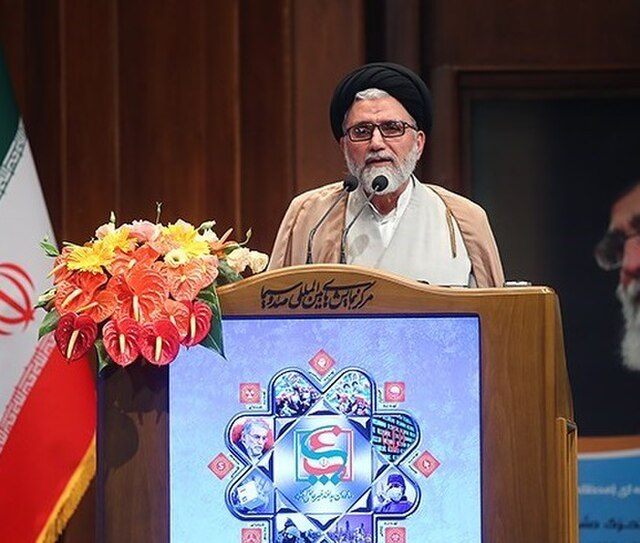
Israel killed three of Iran’s most senior officials in less than 48 hours, a pace of leadership targeting without precedent in the war’s 18 days. Iran’s Intelligence Minister Esmail Khatib was confirmed dead Wednesday, following the confirmed killings of national security chief Ali Larijani and Basij commander Gholamreza Soleimani on Tuesday. Iran’s President Masoud Pezeshkian confirmed all three deaths in a statement on X, calling them “cowardly assassinations.” Israeli Defense Minister Israel Katz warned the day was not over, saying “significant surprises are expected across all arenas.”
Who Khatib Was
Khatib has been Iran’s intelligence minister since August 2021, appointed by ultra-hardliner former President Ebrahim Raisi. When Raisi was killed in a helicopter crash and Masoud Pezeshkian succeeded him, he kept Khatib in his role, an unusual move given that new presidents traditionally replace top ministers with their own associates. Khatib was close to Supreme Leader Ali Khamenei and was viewed as a hardliner who could keep Pezeshkian’s more moderate positions in check. Over the years, the IRGC started to displace aspects of the intelligence ministry’s authority, causing friction between the two bodies. (Jerusalem Post)
Khatib played a significant role in directing the arrests and killings of protesters during the internal protests of recent years and during the 2022-2023 hijab protests. He led terror operations of the Iranian Ministry of Intelligence against American and Israeli targets around the world and against targets inside Israeli territory. (Israel Hayom)
He was sanctioned by the US Treasury in 2022 over alleged cyber operations targeting Washington and its allies. The US State Department had offered a $10 million reward for information on his whereabouts as recently as last Friday. (NPR, Al Jazeera)
Israel’s Standing Kill Authorization
Katz announced the Israeli military would be authorized to “eliminate any senior Iranian official for whom the intelligence and operational circle has been closed, without the need for additional approval.” “We will continue to thwart and hunt them all down,” he added. Netanyahu pulled a small card from his suit pocket after the Larijani and Soleimani killings and told reporters: “Today I erased two names on the punch card.” The implication was clear. There are more names on the card. (Euronews, The National)
Iran’s Reaction
Pezeshkian wrote: “The cowardly assassination of my dear colleagues Ismail Khatib, Ali Larijani, and Aziz Nasirzadeh, alongside some of their family members and accompanying team, has left us in deep mourning.” Iran’s army chief promised a “decisive and regrettable” retaliation. Overnight, Iran launched fresh missile and drone attacks on Gulf states and Israel. Two civilians in their 70s were killed in Ramat Gan, east of Tel Aviv, struck by Iranian cluster munitions. Even when intercepted, cluster weapons disperse submunitions over urban areas that can detonate on impact or remain unexploded. (The National, NPR)
Iran’s IRGC issued an evacuation threat for people living near energy facilities in Saudi Arabia, Qatar and the UAE. Al Jazeera (Al Jazeera)
The Bigger Picture
The death toll in Iran since the war began has surpassed 1,440, with a further 18,700 injured according to the World Health Organisation. An estimated 100,000 people have left Tehran and as many as a million households across Iran have been relocated since February 28.
Thousands of Iranians gathered in Tehran’s Enghelab Square on Wednesday for a joint funeral for Larijani, Soleimani and 84 Iranian navy personnel killed when the frigate IRIS Dena was sunk by a US submarine near Sri Lanka earlier in the war. The funerals for Khatib and the others were initially uncertain given ongoing strikes in the capital.
Israel also struck central Beirut overnight, destroying apartment blocks in some of the heaviest raids on the Lebanese capital in decades. Lebanon’s health ministry reported at least 12 killed and 41 wounded. Israel separately announced it would begin targeting bridges across the Litani River in southern Lebanon to prevent Hezbollah from moving reinforcements. (Guardian, NPR)
Trump hinted Wednesday at a new strategy, posting on Truth Social: “I wonder what would happen if we ‘finished off’ what’s left of the Iranian Terror State, and let the Countries that use it, we don’t, be responsible for the so called ‘Straight?'” The post appeared to float the idea of completing the military campaign and then leaving Hormuz security to allied nations. (Guardian)
Why This Matters to You
Three of the most senior officials in Iran’s national security and intelligence apparatus were killed in under 48 hours. Larijani was the political director of the war effort. Khatib ran the intelligence services that counter Israeli and American espionage. Soleimani commanded the internal paramilitary force that suppresses domestic dissent. Removing all three simultaneously leaves Iran’s security structure without experienced leadership at its most critical moment.
For the rest of the world, Israel’s standing authorization to kill any senior Iranian official without case-by-case approval is an extraordinary escalation. It turns targeted killing from a strategic tool into a systematic policy. Every Iranian official is now effectively operating as a hunted individual. That may deepen the war. It may also open a path to a deal, but only if there are people remaining on the Iranian side capable of making one. It is worth thinking about: With Iran’s political and security leadership being systematically eliminated, is there anyone left with both the authority and the inclination to negotiate a ceasefire? With Israel now bombing central Beirut and targeting river crossings in Lebanon simultaneously with the Iran campaign, has this effectively become one connected regional war rather than two separate conflicts? And with Iran’s IRGC issuing evacuation warnings for Gulf energy infrastructure, how close is the conflict to triggering the large-scale energy facility attacks that analysts have been warning about?
-Elijah Iraheta, Editor in Chief, ASC News

