
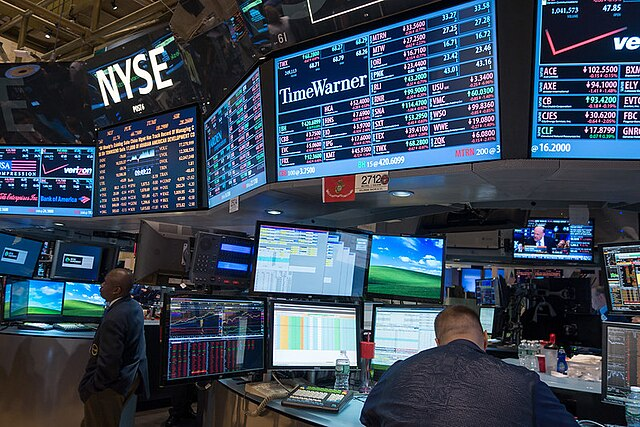
US stocks fell sharply on Monday as oil crossed $100 a barrel for the first time since 2022, raising fears of a stagflationary environment combining rising inflation and slowing economic growth. The moves come as the Iran war enters its tenth day with no sign of resolution and a seventh US service member has been killed.
Oil Breaks $100
West Texas Intermediate crude spiked as high as $119 a barrel overnight before settling around $101 by midday. Brent crude climbed to $102. Both have now risen more than 75% and 60% respectively since the war began on February 28. Oil started the year below $60 a barrel. The surge followed fresh production cuts from Gulf producers. Iraq’s output has fallen by an estimated 70%. Kuwait announced cuts without specifying the volume. Bahrain’s national oil company has also halted production. Saudi Aramco offered prompt crude supply through a rare tender process, which helped trim some of the day’s gains. (CBS News, CNBC)
Roughly 15 million barrels of crude oil, about 20% of the world’s daily supply, typically passes through the Strait of Hormuz each day. That flow has effectively stopped. (CBS News)
Stocks and Global Markets
The Dow fell as much as 945 points before closing down 439 points, or 0.9%. The S&P 500 lost 0.6% and the Nasdaq declined 0.3%. Wall Street’s fear gauge, the Cboe Volatility Index, topped 30 for the first time since the tariff-driven sell-off of April 2025. The Nasdaq dipped below its 200-day moving average for the first time since May 2025.
Global markets also took significant hits. Japan’s Nikkei 225 closed down 5.2% after falling as much as 7% earlier in the session. South Korea’s Kospi sank 6%, triggering a 20-minute trading halt. Taiwan’s benchmark fell 4.4%. European markets lost between 2% and 3% at the open. The US dollar strengthened against major currencies, rising against both the yen and euro. (NPR, AP, Chicago Tribune)
Sectors most exposed to fuel costs fell hardest. Carnival Corporation dropped more than 6%, its worst single day since November. Norwegian Cruise Line fell nearly 5%, its seventh consecutive negative day. Delta, American and United airlines each fell more than 3%. Large US banks including JPMorgan Chase, Citigroup and Bank of America each lost more than 2%. By contrast, energy stocks gained. Exxon Mobil, Chevron and ConocoPhillips each rose around 1%. Defense stocks also advanced, with RTX, Northrop Grumman and Lockheed Martin each up more than 1%. (CNBC)
The Stagflation Warning
The word stagflation, describing a combination of rising prices and stagnating growth not seen since the 1970s oil crisis, has re-entered market commentary with increasing frequency. Ed Yardeni of Yardeni Research raised his probability of a 1970s-style stagflation scenario from 20% to 35% for 2026. “This oil shock won’t end until ships can sail freely through the Strait,” Yardeni wrote. “Until then, the financial markets are likely to become increasingly concerned about a 1970s-style stagflation scenario.” (Fortune, CBS News)
The International Monetary Fund has estimated that every sustained 10% rise in oil prices results in a 0.4% rise in inflation and a 0.15% reduction in global economic growth. Oil has risen more than 75% since the war began. (Al Jazeera)
Yardeni also flagged a risk beyond energy prices. Gulf states are major exporters of fertilizer. If tanker traffic through the Strait does not resume by early April, farmers may be forced to reduce fertilizer use, potentially triggering a food price shock later in 2026. (Fortune)
A Brief Moment of Hope
Oil prices pulled back slightly from their highs after the Financial Times reported that G7 finance ministers were discussing a coordinated release of strategic petroleum reserves with the International Energy Agency. However, the publication also noted that a coordinated release was not yet ready, sending prices back up. Federal Reserve rate cut expectations have shifted from June to September or October as a result of the changing inflation picture. (CNBC, Invezz)
Seventh US Service Member Killed
Vice President JD Vance, speaking at an event in Washington, confirmed the death of a seventh US service member. The Pentagon identified him as Sgt. Benjamin N. Pennington, 26, of Glendale, Kentucky, who died of his wounds on March 8. (CBS News)
Why This Matters to You
Oil at $100 a barrel affects virtually every part of daily life. Gas prices have already risen 50 cents per gallon since the war started and analysts now put the odds of $4 per gallon gas at 80% within the next month. But the concern goes beyond the pump. If Gulf fertilizer exports remain blocked into April, food prices could be the next major pressure point for household budgets.
For investors and retirement savers, a potential stagflation scenario is particularly challenging. Unlike a standard recession, stagflation does not respond well to interest rate cuts because cutting rates risks making inflation worse. It is worth thinking about: If the Strait of Hormuz remains closed for another two to three weeks, at what point do G7 nations move from discussing a strategic reserve release to actually executing one? With the Federal Reserve now pushed toward a September or October rate cut, how much financial stress will households face in the intervening months? And with a seventh American now dead, how is the human cost of this conflict factoring into the political calculus in Washington?

