
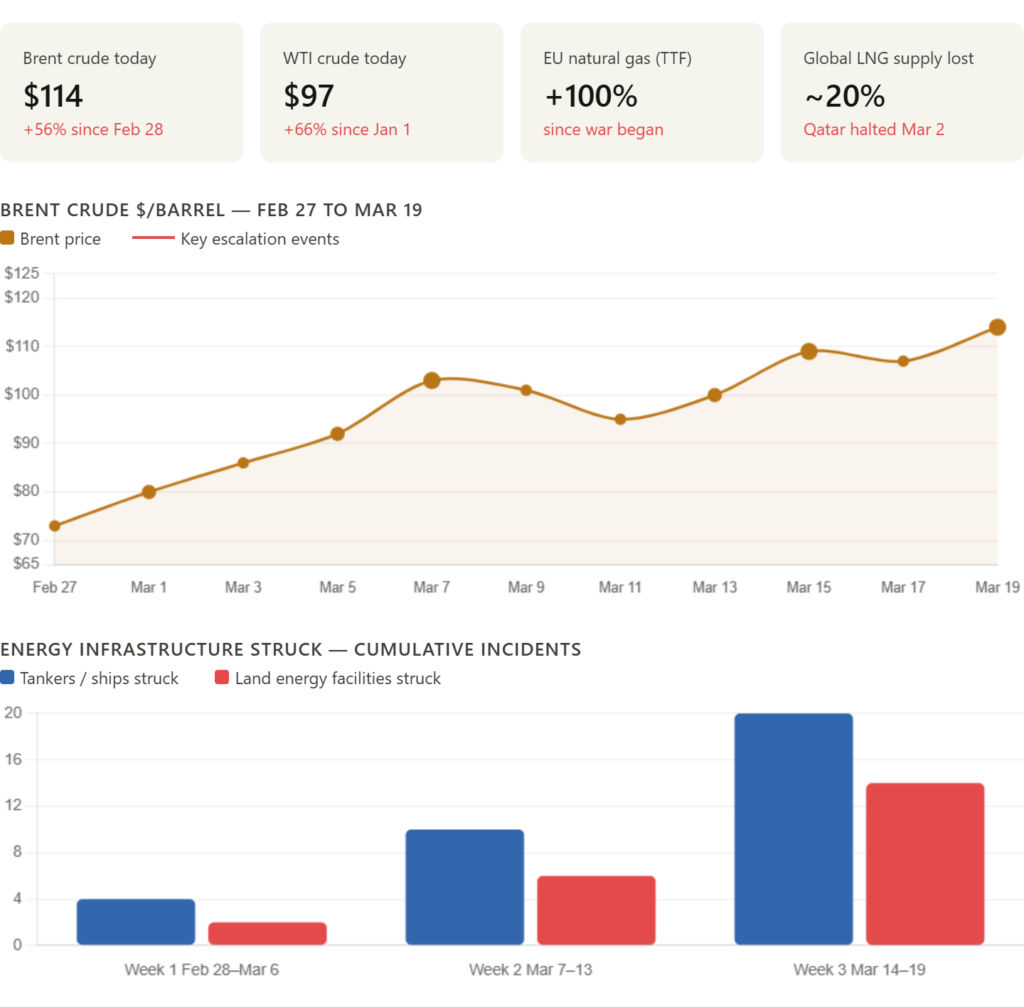
Stocks fell again Thursday as oil prices surged to new war-era highs following a dramatic escalation in energy infrastructure strikes. Iran attacked the world’s largest LNG facility in Qatar, Kuwait’s refineries were hit, Saudi Arabia intercepted strikes on Riyadh and the UAE suspended operations at two major gas facilities. Brent crude briefly crossed $119 a barrel before settling up 6% near $114, its highest since July 2022. The Dow fell 315 points, the S&P 500 slipped 1% and the Nasdaq lost 1.3%. European natural gas prices surged 17% and have now doubled since the war began on February 28.
The Qatar Strike
QatarEnergy said Wednesday its Ras Laffan LNG hub had sustained extensive damage after being attacked by Iranian missiles twice in 12 hours. Ras Laffan is the largest LNG facility in the world, according to the IEA. Iran’s attack came after an Israeli strike targeted Iran’s South Pars gas field, part of the world’s largest natural gas reserve shared between Iran and Qatar.
Global LNG supply had already shrunk by almost a fifth since QatarEnergy halted LNG production on March 2 following an earlier Iranian attack. Qatar normally supplies approximately 20% of the world’s LNG consumption. Wood Mackenzie, a data analytics firm focused on energy, said the damage to Ras Laffan fundamentally alters the global gas market outlook. (CNN, Fortune)
Iran also sent out a target list of energy facilities it planned to strike, naming Saudi Aramco’s Samref refinery and Jubail petrochemical complex and the Al Hosn gas field in the UAE as specific targets. Two oil refineries in Riyadh came under attack, according to Saudi Foreign Minister Prince Faisal bin Farhan. Kuwait Petroleum Corporation said fires erupted at two of its refineries following drone attacks in the early hours before being extinguished. (Fortune, CNN)
Trump’s Split With Israel
Trump admitted he “knew nothing” about Israel’s strike on South Pars, suggesting a significant split between Washington and Tel Aviv over war strategy. He said there would be no more attacks on South Pars unless Iran struck Qatar again, and pledged to dial down the intensity of attacks. He said: “Qatar was in no way, shape, or form involved with it, nor did it have any idea that it was going to happen. Unfortunately, Iran did not know this.” wkyt (Fortune)
Earlier in the week Trump had threatened to blow up all of South Pars if Qatar was attacked again. He walked that back Thursday, telling reporters it was Iran that needed to understand the consequences, not Qatar. Despite the softer tone on South Pars, 2,200 US Marines aboard the USS Tripoli are heading to the Middle East from Japan and are expected to arrive in approximately ten days.
The Fed and Inflation
The Federal Reserve held its benchmark rate steady on Wednesday. Fed Chair Jerome Powell said “we just don’t know” what will happen with oil prices or how long tariffs will take to work through the system. A report released Wednesday showed US wholesale inflation unexpectedly accelerated last month to 3.4%. Markets are now pricing an 80% probability the Fed holds rates for the rest of 2026 unless conditions change substantially.
Gulf Oil senior energy advisor Tom Kloza warned that markets could enter an all bets are off scenario if the conflict spreads beyond the Gulf and begins targeting energy infrastructure in other regions. “Can you imagine the response in the world if Iran targeted something outside of the Persian Gulf, a refinery in Rotterdam or a facility somewhere in the United States, that’s when all bets are off and prices could go absolutely apocalyptic,” he said. (CNBC)
Micron and Markets
Micron fell 7% Thursday despite reporting quarterly revenue that nearly tripled year over year, driven by surging demand for high-bandwidth memory used in AI data centers. Analysts attributed the drop to profit taking after the stock’s 60%+ run this year. Japan’s Nikkei fell 3.4% and South Korea’s KOSPI tumbled nearly 3% as Asian markets absorbed the latest energy shock. Japan and South Korea depend on imported fossil fuels for 80 to 90% of their energy needs and are among the world’s largest LNG importers. The Bank of Japan kept rates on hold at 0.75%, explicitly citing the Iran war as a factor. (AP, Al Jazeera)
Why This Matters to You
Thursday’s session may be the most consequential trading day of the war so far. Iran is no longer just threatening energy infrastructure. It is systematically targeting it across four countries simultaneously. Qatar’s Ras Laffan, the world’s largest LNG facility, has been extensively damaged. Kuwait’s refineries were hit. Saudi refineries in Riyadh came under attack. The UAE suspended two major facilities preemptively. Every one of these escalations filters directly into the price of heating your home, fueling your car and buying food that was grown with fertilizer shipped by sea.
The analyst quoted in this article said it plainly: the only solution for reopening the Strait of Hormuz is a diplomatic settlement, and right now almost no effort is being put into achieving one. It is worth thinking about: With Trump admitting he knew nothing about Israel’s South Pars strike, how coordinated is the US-Israeli military strategy actually being? With European natural gas prices doubling in three weeks and Ras Laffan extensively damaged, which countries face energy rationing first if the war extends into April? And with the Fed holding rates, oil at $114 and wholesale inflation at 3.4% before the war’s energy shock has even shown up in the data, how close is the US economy to a recession?
-Elijah Iraheta, Editor in Chief, ASC News

