
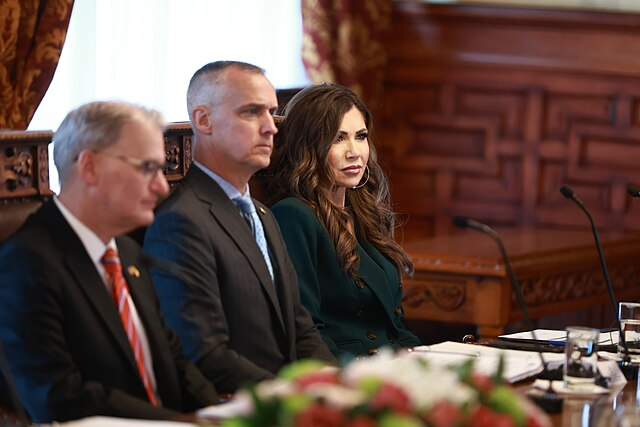
A seven-month NBC News investigation has found that multiple Department of Homeland Security contractors told White House officials they were asked to pay Corey Lewandowski, a close Trump ally who served as an unpaid special government adviser at DHS, in exchange for securing or maintaining federal contracts. Lewandowski has categorically denied all of the allegations. It is not confirmed whether he received any money from any government contractors.
The GEO Group Allegation
The most detailed account involves The GEO Group, the nation’s largest private prison company, which had more than $1 billion in annual DHS contracts and stood to benefit enormously from Trump’s mass deportation agenda. According to two industry sources and a senior DHS official, Lewandowski told GEO Group founder George Zoley during the presidential transition, before Lewandowski officially held a government role, that he wanted to be paid in exchange for protecting and growing the company’s DHS contracts. Zoley declined. A second meeting in early 2025 went no better. Zoley offered to put Lewandowski on retainer but Lewandowski rejected it, saying he wanted compensation based on new or renewed contracts, what one source described as a success fee. Zoley again refused.
In the months that followed, two of GEO Group’s federal contracts were shortened and several of its detention facilities sat idle, even as Congress poured money into DHS for deportation operations. A senior DHS official told NBC News that shortly after the second meeting, Lewandowski told him not to award more contracts to GEO Group. GEO Group officials believe the contract losses were directly tied to their refusal to pay. In December 2025, GEO Group did receive a new $121 million contract. Lewandowski’s spokesperson said the GEO Group account is “absolutely false and did not happen.” (NBC News)
The Marketing Firm Account
A separate company, an unnamed marketing firm with no prior federal contracting experience, was approached through Salus Worldwide Solutions, a firm that had won a fast-tracked DHS deportation contract worth nearly $1 billion. According to a person familiar with the discussions, a Salus representative told the marketing firm owner that he could win a $20 million DHS subcontract but would need to hire a consultant to “manage the relationship” and “properly thank” the person who secured it, naming Lewandowski. The firm refused. It was told it would not get the deal as a result.
A follow-up call offered a second opportunity, this time worth $40 to $50 million, but with $20 to $30 million directed to a Lewandowski-linked consulting firm. The marketing firm refused again. A lawyer for Salus called both accounts “entirely false” and said Salus “would never entertain this type of arrangement.” Lewandowski’s spokesperson called the allegations “patently false.” (NBC News, Salus via NBC News)
The Scope of the Investigation
GEO Group and several other companies in government contracting complained to officials in Trump’s inner circle that Lewandowski, as a special government employee, has directly or indirectly stood to personally profit from the DHS contracting process, according to four senior White House officials, a former White House official and a person familiar with the conversations. A senior White House official acknowledged receipt of “a dozen” complaints from at least four companies.
White House officials have not taken any action against Lewandowski, in part out of fear that Trump will come to his defense. Trump has separately been asking aides whether Lewandowski profited from the $220 million DHS advertising campaign, at one point reportedly saying “Corey made out on that one.” (NBC News)
The White House Counsel’s Office opened an inquiry into Lewandowski’s potential abuse of the special government employee role. House Oversight ranking members Robert Garcia, Rick Larsen and Bennie Thompson separately called on the DHS Inspector General to investigate Lewandowski’s influence over contract decisions. The Republican-led House Homeland Security Committee is also conducting its own investigation, and has taken interest in Kara Voorhies, a contractor who worked closely with Lewandowski and reportedly wielded outsized influence over FEMA contracts. (House Oversight Democrats, NOTUS)
Noem’s Contradicted Testimony
ProPublica reported that Noem misled Congress when she flatly denied that Lewandowski played any role in approving contracts. Internal DHS records reviewed by ProPublica showed Lewandowski’s signature appearing on contract routing sheets as the final sign-off before Noem’s own signature. Last year, Noem imposed a new policy requiring her to personally review and approve all contracts above $100,000, down from the previous $25 million threshold, consolidating oversight in her office and that of her top aides. (ProPublica)
Lewandowski reportedly told at least one person that he was “not worried” about scrutiny because Trump would pardon him. He denied making that statement. Lewandowski has said he has not decided whether he will leave DHS when Noem departs on March 31. (Patriot Post Daily, NBC News)
Why This Matters to You
Federal contracting is how taxpayer money gets spent. DHS alone has a budget in the hundreds of billions of dollars. If the allegations in this investigation are accurate, a single unelected and largely unsupervised special government employee was potentially steering billions in federal contracts toward companies willing to pay him and away from those that refused. That is not a bureaucratic concern. That is a direct misuse of public money.
The fact that a dozen companies complained to the White House and no action was taken, combined with the White House Counsel’s Office opening its own inquiry while also declining to act, reflects an accountability gap that has rarely been seen at this level of government. It is worth thinking about: What legal protections exist for companies that refuse to participate in alleged pay-to-play schemes and then lose government contracts as a result? With Lewandowski’s financial disclosures protected from public release under the special government employee designation, what oversight mechanism can actually verify whether he received outside payments? And with Trump reportedly asking whether Lewandowski profited from the ad campaign while simultaneously declining to act on the complaints, what does that suggest about how accountability functions inside this administration?
-Elijah Iraheta, Editor in Chief, ASC News

