
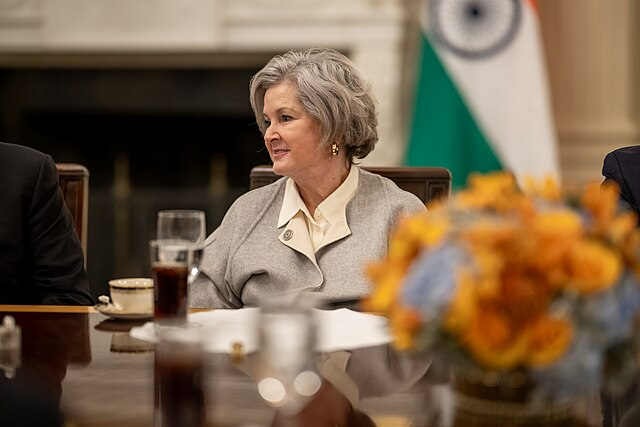
White House Chief of Staff Susie Wiles, 68, has been diagnosed with early-stage breast cancer. President Trump announced the diagnosis Monday on Truth Social, saying her prognosis is excellent and that she will remain in her role while undergoing treatment. Wiles confirmed the diagnosis herself in a statement on X, saying she was grateful for early detection and encouraged by a strong prognosis. She has not yet determined an exact course of treatment.
Who Wiles Is
Wiles is the first woman to serve as a president’s chief of staff. She has been a fixture in Republican politics for decades, working on campaigns for Mitt Romney, Rick Scott and, eventually, Donald Trump. She became co-campaign manager alongside Chris LaCivita in 2022 and managed Trump’s successful 2024 presidential campaign. Trump has repeatedly praised her publicly, calling her the “most powerful woman in the world” and affectionately dubbing her “Susie Trump.” She takes part in nearly every major decision Trump makes and has assembled a West Wing staff described as deeply loyal to both the president and to her. (Axios, CNN, CNBC)
Her management style has been notably different from chiefs of staff in Trump’s first term. Rather than trying to constrain the president, she has focused on managing the day-to-day operations of the White House around him. That approach has earned her his sustained confidence in a way her predecessors did not. (CNN)
The Announcement
Trump revealed the diagnosis during a Truth Social post on Monday, saying Wiles had chosen to begin treatment immediately rather than wait. “Her Strength and her Commitment to continue doing the job she loves, and does so well, while undergoing treatment, tells you everything you need to know about her,” he wrote. A short time later, Wiles appeared seated next to Trump at a Kennedy Center board meeting at the White House. Trump noted she had already started treatment. “She just started actually and she’s going to be in great shape,” he said, patting her on the back as he spoke. At one point during the meeting, Wiles leaned over and whispered “Pepe” after Trump mistook sugar baron Alfie Fanjul for his brother. Trump quickly corrected himself. (Axios, Washington Post)
Deputy White House Chief of Staff James Blair, described as a close Wiles understudy, wrote on X: “Susie led President Trump’s team through illegitimate indictments, domestic spying by the former administration, rigged federal prosecutions, illegal law enforcement raids, general lawfare, assassination attempts, and more. As with the rest, she will win this battle with grace.” (Axios)
About Breast Cancer
Breast cancer is the most common cancer in women in the United States after skin cancer. Approximately one in eight American women will receive a breast cancer diagnosis in their lifetime. The median age of diagnosis is 62. Treatment options depend on the type and stage of cancer and can include surgery, radiation, chemotherapy, hormone therapy, immunotherapy and targeted drug therapy. Early-stage diagnoses carry significantly higher survival rates than late-stage ones. (American Cancer Society via CNN)
Why This Matters to You
Susie Wiles is not a cabinet secretary or an elected official. She is the person who runs the day-to-day operations of the White House at one of the most consequential moments in recent American history, during an active war in Iran, a partial government shutdown, a trade standoff with China and a midterm election year. Her continued presence in the role matters to the functioning of the administration.
Her public statement also carries a broader message. One in eight American women will face a breast cancer diagnosis in their lifetime. Early detection, the kind she benefited from, is the single most important factor in a positive outcome. It is worth thinking about: With Wiles planning to work through treatment, what support systems exist in the White House for a chief of staff managing a significant health challenge alongside an unusually demanding portfolio? And with her diagnosis coming at the same moment that Health Secretary RFK Jr. is reshaping federal health policy, does her experience draw any additional attention to the importance of routine cancer screening programs that are currently under budget review?
-Elijah Iraheta, Editor in Chief, ASC News